
- Yield curve control impacts traditional banking and non-bank financial institutions by influencing interest rate expectations.
- Shadow banking presents liquidity risks due to its reliance on short-term funding, which may be exacerbated by yield curve manipulations.
- Private credit markets face contagion risks, particularly when yield curve control creates artificial stability or volatility in interest rates.
- Institutional investors must monitor yield curve policies closely to manage exposure to shadow banking and private credit risks.
- Efficient risk management strategies are critical for institutions navigating the intertwined dynamics of yield control and shadow banking.
“Liquidity is a coward; it disappears at the exact moment you need it most.”
Macro-Economic Context & Structural Imbalances
As we stand in Q2 2026, the global economic environment is being tangibly influenced by the multifaceted policy tool known as Yield Curve Control (YCC). YCC has readily become a staple within the monetary policy arsenal of major central banks, particularly in response to turbulent economic conditions characterized by persistent inflation and atypical growth patterns. The essence of YCC lies in its attempt to anchor longer-term interest rates, which historically offered risk-free returns, into policy objectives rather than active market dynamics.
The structural imbalance emerges when shadow banking and private credit intertwine with these controlled yield environments, resulting in unforeseen liquidity strains. Shadow banking systems, largely opaque and less regulated, persistently expand in this milieu. Private credit, often extending into higher-risk lending, capitalizes on the thin spreads resulting from suppressed yield curves. Nevertheless, this brings forth contagion risks as potential default rates in private credit exacerbate due to the mismatch between the liquidity of short-term funding and the illiquidity of long-term assets. As capital funnels into these areas seeking higher returns, the inherent risks are masked, giving rise to an intricate interdependence that threatens systemic stability.
“With the compression of traditional yield curves, the reach-for-yield phenomenon escalates risk-taking behavior in shadow banking operations” – IMF
Quantitative Impact on Asset Pricing
In the tangled dance between controlling the yield curve and the resultant shadow risks, asset pricing dynamics display increased asymmetry. The liquidity premium associated with riskier assets is now reflected not just in the level of rates but in their stability over time. YCC effectively flattens the yield curve, reducing term premiums and, inadvertently, incentivizing duration extension across portfolios. As financial institutions adjust their duration exposures, convexity becomes paramount. Portfolios heavily weighted towards fixed income are particularly vulnerable to shifts in policy direction, where even marginal alterations can lead to disproportionate valuations changes due to convexity effects.
The private credit market, buoyed by suppressed traditional borrowing costs, now finds itself in a precarious positing with escalating credit spreads indicating lurking default risks. An environment characterized by heightened uncertainty, accommodations, and evasive tail-risk mitigation techniques exacerbates the pricing mechanisms. The crux lies in understanding the contango inherent to forward curves, influencing the derived values of derivative instruments widely used for hedging.
“The propagation of credit contagion within private sectors against a backdrop of constrained interest rate environments magnifies tail-risk across interconnected financial networks” – BIS
PORTFOLIO REBALANCING DIRECTIVE
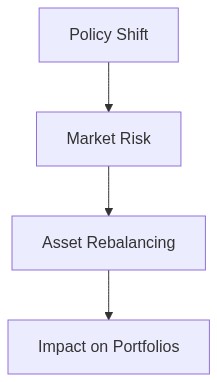
Amidst the constraints imposed by YCC, it is crucial to pivot towards asset classes exhibiting both upward duration stability and intrinsic growth opportunity. Maintaining a diversified allocation into quality equities, especially those with strong cash flow resilience, becomes pivotal in sustaining alpha generation.
Step 2 (Risk Mitigation & Hedging)
Leveraging derivative instruments with strategic convexity adjustments can safeguard against abrupt rate increases. Considering the liquidity premium within selected private credit instruments is essential; hence, adopting layered credit default swaps (CDS) will mitigate potential spread widening impacts.
Step 3 (Liquidity Management & Stress Testing)
Augmented liquidity management protocols are imperative in navigating the complex web of shadow banking liquidity risks. Regular stress testing simulations rooted in staggered rate environment variants will aid in preemptive risk identification.
As I dissect these components, the underlying thesis remains true prudent navigation through YCC and shadow banking realms demands a marriage of traditional asset valuation with adaptive risk mitigation strategies. In an era where liquidity and risk premiums dictate conversations, a decisive step into innovation-driven asset management becomes non-negotiable. The impending evolution requires tactical foresight, robust analytical frameworks, and an unwavering eye on the undercurrents of financial contagion.
| Aspect | Retail Approach | Institutional Overlay |
|---|---|---|
| Strategy Complexity | Low Focuses on straightforward bond ladders | High Integrates advanced derivative strategies |
| Portfolio Diversification | Limited Primarily domestic bonds and ETFs | Extensive Global fixed income and cross-assets |
| Yield Curve Positioning | Static Basic duration targeting | Dynamic Flexible duration overlay |
| Shadow Risk Management | Reactive Insurance products as risk buffer | Proactive Risk offsetting with derivatives |
| Investment Horizons | Short to Medium 1 to 5 years | Varied Monthly to over 10 years |
| Leverage Utilization | N/A Generally avoided | Strategic Utilized for yield enhancement |
| Cost Efficiency | Moderate Expense ratios and fees | Optimized Institutional pricing benefits |
| Regulatory Constraints | Standard Adheres to retail compliance | Complex Navigates sophisticated regulatory landscapes |
| Performance Metrics | Benchmark Retail indices | Alpha Pursues excess returns over benchmarks |
| Liquidity Considerations | High Liquid assets are prioritized | Tailored Liquidity based on market opportunities |