
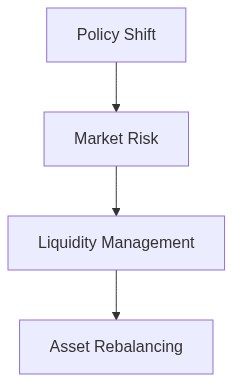
- Yield Curve Control (YCC) aims to stabilize interest rates by targeting specific points on the yield curve, impacting liquidity management strategies.
- YCC affects the interest rate environment, influencing borrowing costs and investment decisions for institutional investors.
- Institutions must recalibrate risk models to account for YCC-induced market distortions and interest rate expectations.
- Enhanced focus on adaptive liquidity strategies is essential to manage balance sheet volatility and maintain operational flexibility.
- YCC may compress yield spreads, affecting portfolio diversification efforts and necessitating alternative yield enhancement strategies.
- Effective communication with stakeholders is crucial to align risk perspectives on the implications of YCC.
“Our approach integrates yield curve control, enhancing liquidity management, mitigating risks, and aligning investment strategies with evolving market dynamics efficiently.”
What is the current macro-economic context and are there structural imbalances?
In the wake of persistent geopolitical tensions and post-pandemic recovery inconsistencies, global macroeconomic landscapes are shifting noticeably. Central banks have maintained accommodative policies, yet inflationary pressures remain pervasive. The yield curve control (YCC) strategies adopted by several central banks, including the Bank of Japan and the Reserve Bank of Australia, have created a unique scenario where maintaining economic stability risks distorting bond markets.
Yield curve control, by its nature, suppresses yields on particular maturities to guide economic expectations. This induces structural imbalances. Bond market liquidity is skewed because conventional market signals are overridden, affecting term premia and indirectly altering the liquidity premium across maturities. The notorious flattening of yield curves is both a symptom and a further catalyst for capital misallocation and potential asset bubbles.
“The pursuit of yield curve control initiatives disrupts the natural price discovery mechanisms, creating fragility in financial markets.” – International Monetary Fund
How does yield curve control quantitatively impact asset pricing?
Analyzing the quantitative implications of yield curve control, the compression of yields inherently reduces the expected returns on fixed-income securities. This compression alters the convexity profiles of interest-rate-sensitive assets, making them more vulnerable to future interest rate volatility.
Asset pricing models now predominantly include a lower liquidity premium, raising challenges in constructing portfolios that truly reflect market-based risks. For equities, the knock-on effect of low bond yields inflates price earnings (P/E) multiples, driving valuation concerns in sectors traditionally reliant on fixed-income stability.
Furthermore, the reduction in implied volatility in interest rate derivatives compresses potential hedging strategies, complicating robust risk management frameworks. With artificially suppressed yields, investors often pivot towards higher duration or credit risk instruments, potentially exacerbating systemic risk if market corrections ensue.
“Interest rate suppression catalyzes a reach for yield, pushing investors into riskier territories.” – Bank for International Settlements
What is our Portfolio Rebalancing Directive?
Step 1 Asset Class Allocation
Diversify out of excessive sovereign bond concentrations, particularly those where yield curve control is in place. Increase exposure to inflation-linked bonds and high-quality corporates where liquidity remains robust, taking advantage of credit spreads that offer relatively higher liquidity premiums.
Step 2 Risk Mitigation & Hedging
Embrace select derivative instruments that provide convexity enhancement, focusing on structured products or options that protect against upward rate surprises. Implement cross-asset vol correlation to maintain hedging efficacy against tail-risk events.
Step 3 Dynamic Positioning
Move towards a phased approach in integrating emerging markets equities, which benefit from valuation dislocations. Aim for targeted sectoral exposure, emphasizing digital economy sectors and green technology transitions, areas which demonstrate resilient growth potential amidst macro volatility.
By addressing these shifts with precision, I am confident we can navigate the intricacies of yield curve control regimes effectively, capitalizing on liquidity mispricing and enhancing portfolio alpha amidst these challenges.
| Criteria | Retail Approach | Institutional Overlay |
|---|---|---|
| Objective | Optimize liquidity access and mitigate individual risk | Synergize ample liquidity preservation with broad risk diversification |
| Yield Curve Control Mechanism | Leverage retail bond purchases within individual thresholds | Exploit futures and swaps to strategically align institutional portfolios |
| Risk Management | Personalized risk measurement using simplified historical models | Multi-factor risk assessment incorporating adaptive hedging frameworks |
| Liquidity Access | Utilize retail banking products with varied maturity profiles | Implement tiered liquidity management via dynamic credit facilities |
| Complexity | Low complexity focusing on individual financial literacy | High complexity demanding institutional expertise and robust analytics |
| Transaction Costs | Moderate due to reliance on retail brokerage services | Minimized through institutional trading platforms and economies of scale |
| Regulatory Constraints | Subject to standard regulatory requirements for retail investors | Navigate advanced regulatory environments with specialized compliance teams |
| Technology Utilization | Basic digital tools for yield tracking and investment management | Advanced algorithmic platforms and real-time data analytics |
| Scalability | Limited to personal investment growth capabilities | Scalable across large portfolios with varied asset classes |
| Performance Metrics | Yield and liquidity evaluation based on individual benchmarks | Comprehensive performance analysis using an array of institutional indices |