
- Central banks are aggressively pursuing balance sheet reduction through quantitative tightening (QT), which is impacting market liquidity.
- Sovereign debt yields have been rising, prompting a strategic reassessment of fixed-income allocations.
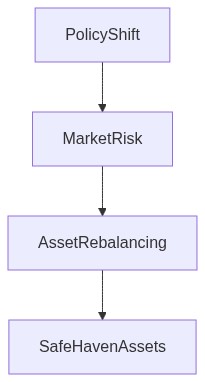
- Investors are flocking to safe haven assets like gold and the US dollar to mitigate risks associated with volatile market conditions.
- Gold’s traditional role as an inflation hedge remains relevant, particularly during periods of monetary policy tightening and geopolitical instability.
- The USD continues to be a global reserve currency of choice amid T-bill demand and geopolitical tensions.
- Institutional investors are exploring dynamic hedging strategies to manage exposure to currency and interest rate fluctuations.
“We do not forecast the future. We construct portfolios resilient to multiple futures.”
Safe Haven Assets Amid QT and Rising Yields
Macro-Economic Context & Structural Imbalances
In the current economic landscape, we are observing a period where central banks are executing balance sheet reductions at an unprecedented scale. As QT (Quantitative Tightening) unfolds, the implications are multifaceted, causing concerns about the liquidity premiums previously compressed during expansive monetary policies. Central banks, notably the Federal Reserve and the Bank of England, are now strategically addressing inflated balance sheets, which has led to a systemic reassessment of sovereign debt yields.
Historically low yields have reversed, prompting a decompression of risk premia and a rise in convexity within fixed-income securities. Structural imbalances are emerging as yield curves steepen, exacerbating tail-risks in duration-heavy investments. Central banks are reducing their bond purchase programs, quae eroding the vast liquidity sanctuary that had underpinned asset prices since the global financial crisis.
“The balance sheet normalization process has introduced elevated uncertainty into financial markets, amplifying the risk premium demanded by investors” – International Monetary Fund
Quantitative Impact on Asset Pricing
The gradual unwinding of central bank assets has profound effects on asset pricing mechanisms. Investors are now grappling with increased risk aversion, repricing expectations across asset classes. Rising sovereign yields are a direct consequence of diminished quantitative easing efforts. The liquidity premium from previously limited bond supply is transitioning into heightened yield demands, triggering a recalibration of cash flow discounting practices.
This recalibration is evident in risk-averse asset classes. Gold, traditionally a quintessential safe haven asset, is exhibiting renewed vigor as a hedge against financial market volatility. Meanwhile, sovereign debt, during this tightening phase, faces mounting pressures as investors demand higher returns proportional to the escalating default and duration risks.
“The shift in monetary policy paradigms has led to an observable inversion of the contango curves in commodity markets” – Bloomberg
Step 1 (Asset Class Allocation) Augment exposure to precious metals and commodities with a well-reasoned allocation toward gold and critical non-cyclical assets. Reassess traditional fixed-income instruments with an emphasis on bonds exhibiting favorable convexity properties.
Step 2 (Risk Mitigation & Hedging) Incorporate tactical hedging strategies employing derivatives to offset adverse shifts in sovereign yield curves. Consider options and futures to obscure portfolio tail-risk exposure, effectively managing downside potential.
Step 3 (Liquidity & Capital Efficiency) Enhance liquidity through strategic deployment into liquid assets with low transaction costs, thus preserving capital during periods of rate-induced market constriction.
Conclusions and Forward Projections
The current environment dictates a paradigm shift in the perception and management of safe haven assets. As QT persists, the narrative of risk-adjusted returns must evolve. Vigilance in monitoring central bank communications and data on macroeconomic indicators will be pivotal. The ability to adapt portfolio strategies to this dynamically evolving landscape will be the cornerstone of sustained alpha generation amid tightening financial conditions.
As your CIO, I advise on strategic agility in asset allocation, carefully weighing the intrinsic characteristics of diverse asset classes. Transforming uncertainty into opportunity lies in the adept maneuvering across financial contours dictated by this era of quantitative tightening and rising yields.
| Aspect | Retail Approach | Institutional Overlay |
|---|---|---|
| Asset Allocation | Predominantly bonds and precious metals. Higher allocation towards TIPS and gold ETFs. Limited currency diversification. | Robust multi-asset strategies with tailored derivatives overlay. Strategic currency hedging and dynamic reallocation. |
| Risk Management | Primarily focused on historical volatility analysis. Lacks stress testing against macroeconomic shocks. | Advanced risk metrics such as Value-at-Risk (VaR) and Conditional VaR utilized. Frequent scenario stress testing and risk attribution models. |
| Yield Enhancement Techniques | Basic yield strategies. Limited use of income-generating instruments like covered call ETFs. | Sophisticated use of options strategies and active duration management. Comprehensive focus on total return enhancement. |
| Portfolio Customization | Generalized allocation models with limited customization. Often constrained by mutual fund offerings. | Highly bespoke solutions with individualized risk profiles. Incorporation of bespoke financial instruments. |
| Macroeconomic Sensitivity Analysis | Reactive adjustments to monetary policy news. Limited predictive analytics and forecasting capabilities. | Proactive policy anticipation leveraging econometric models. Strategic alignment with central bank policy expectations. |
| Technology and Analytics | Use of standard toolsets and online platforms. Data-driven decisions primarily from public domains. | Cutting-edge proprietary algorithms and AI-driven insights. High-frequency trading capabilities with big data analytics. |
| Cost Efficiency | Cost-sensitive strategies. Predominantly index funds and low-cost ETFs. | Economies of scale leveraged with in-house execution. Precision trading reduces transaction costs. |