
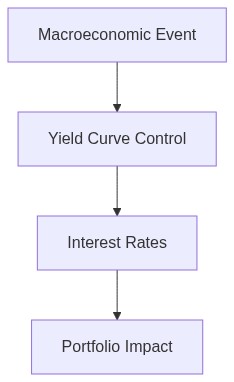
- The Bank of Japan maintains an aggressive yield curve control (YCC) policy to cap long-term interest rates, which could weaken the yen.
- A weaker yen might drive Japanese investors towards gold as a safe haven, increasing global gold demand.
- Rising demand for gold could be further fueled by global de-dollarization trends as institutions seek to diversify away from the US dollar.
- The interplay between Japanese monetary policy and global gold markets could significantly impact institutional investment strategies.
- If the BoJ tweaks or exits YCC, it may lead to dramatic shifts in global financial markets, particularly affecting safe haven assets like gold.
“The market is a mechanism for transferring wealth from the impatient to the prepared.”
BoJ’s Yield Curve Control Catalyst for Gold Surge?
Decoding the Dynamics Unveiling Yield Curve Control’s Implications
The Bank of Japan’s foray into yield curve control (YCC) epitomizes a significant epoch in the global monetary policy landscape. Instituted to cap the yield on 10-year Japanese Government Bonds (JGBs), the YCC policy seeks to exert influence over long-term interest rates and anchor them near zero. Cognizant of its implications, seasoned investors recognize that this monumental policy shift bears consequential effects on asset classes beyond the confines of traditional bond markets. As the BoJ meticulously calibrates the yield curve by modulating bond purchases, the resulting distortion in bond prices introduces a host of repercussions, notably impacting the allocation stance towards gold. The inherent complexity embedded in this strategy necessitates a discerning gaze to unravel the idiosyncratic relationships it fosters within the broader macroeconomic tapestry.
The yield curve, embodying the term structure of interest rates, serves as a vital indicator of economic expectations and inflationary anticipations. With the BoJ’s assertive intervention, the suppression of long-dated yields engenders a heightened degree of convexity within the bond market. As convexity amplifies, the pricing mechanisms of bonds become acutely sensitive to fluctuations in interest rates, engendering heightened volatility in valuation. Consequently, asset managers are prompted to reassess portfolio diversification strategies, redistributing allocations towards non-interest-bearing assets such as gold. Gold’s intrinsic value proposition as a hedge against inflationary risks and currency depreciation is augmented within the milieu of artificially suppressed interest rates. Investors, attuned to these considerations, increasingly perceive gold as an indispensable instrument in safeguarding real returns within the realm of an engineered flat yield curve.
Moreover, the BoJ’s YCC policy concomitantly reshapes the risk premium associated with Japanese sovereign debt instruments. As the central bank exerts downward pressure on yields, the contraction of the liquidity premium exacerbates concerns surrounding the true opportunity cost of capital deployment. This decline in risk-adjusted returns renders JGBs comparatively unattractive relative to alternative asset classes. When coupled with anticipated currency depreciations due to escalated monetary base expansions, gold emerges as an unparalleled refuge for investors seeking to mitigate sovereign credit risks inherent in a subdued yield curve environment. It is noteworthy that the persistent negative correlation between real interest rates and gold substantiates the assertion that YCC inadvertently champions gold’s ascent as a leading asset in an era marked by fiscal experimentation.
The Macro Relativity Global Monetary Policy Synchronization and Gold’s Appeal
The entrenchment of yield curve control in Japan transcends domestic boundaries, propelling cross-continental reverberations that augment gold’s allure amidst an evolving macroeconomic convergence. As global central banks calibrate their own policy levers in response to Japan’s YCC, the synchronized convergence of interest rates engenders a reallocation of capital flows. The distorted landscape of fixed-income securities provokes astute investors to reassess their strategic stance vis-à-vis precious metals. The United States Federal Reserve, with its tightening trajectory, remains a harbinger of the spillover effects that emerge as Japanese yield curves bow under monetary pressure, fostering an environment conducive to gold’s prominence.
Institutional insight recognizes that as the BoJ’s policy initiatives intertwine with those of major central banks, the resulting distortion yields a complex interplay of currency dynamics and inflation expectations. The Bank for International Settlements aptly notes, “Globalized financial markets heighten the need for international policy coordination,” highlighting the strategic imperative of understanding how Japan’s YCC paradigm reshapes global monetary dynamics. The intrinsic liquidity inherent within gold markets, devoid of performance lag tied to interest payments, provides a compelling alternative to sovereign fixed-income instruments seeking to preserve real returns. This diversification impulse catalyzes an increasing migration towards gold, particularly in a milieu where negative interest rates become more pervasive and asymmetric policy outcomes magnify contagion risks.
The burgeoning recognition of transnational policy synchronization further impacts gold’s term structure, engendering price contango as storage costs and convenience yields fluctuate with macroeconomic verisimilitude. The convexity inherent in international monetary policy paths, combined with a magnified policy divergence between Japan’s YCC and other global rate destinies, amplifies the geopolitical and economic uncertainty veiling traditional investment vehicles. Such dynamics precipitate recalibrations in risk allocations, not merely isolated within Japan’s economic sphere but extending globally to reformulate allocations towards gold as an anchor of stability and wealth preservation.
Gold in the Flux Liquidity, Volatility, and the Strategic Imperative
The dawning of yield curve control by the BoJ heralds a consequential recalibration in liquidity landscapes that entwine gold’s role within institutional portfolios. With JGB yields firmly pegged by the BoJ, market liquidity undergoes a transformation where crowded trades within the fixed-income space engender heightened volume and volatility spillovers. Savvy elite fund managers decipher these nuances, calibrating liquidity-driven shifts to elevate gold’s position as a hedge against short-term funding volatility and a bulwark in the face of yield-induced asset price bubbles. The BoJ’s artificial suppression of interest rates invigorates the volatile ebbs and flows experienced in currency markets, precipitating allure and liquidity into gold as a low-correlation asset capable of mitigating erratic shifts in market equilibrium.
Gold’s liquidity premium derives its allure within the intricacies of YCC-induced volatility, offering a dynamic mechanism to navigate moments of convexity. The Interbank Rate Markets reverberate with uncertainty, prompting astute investors to conflate short-term liquidity optimization strategies with longer-term hedging commitments. “The liquidity management function necessitated by YCC mandates an acute awareness of gold’s stratagem,” comments the Bank for International Settlements, elucidating the intricacies underpinning this strategy. The contemporary monetary milieu imposes exigent demands for dexterous asset rotation strategies, prompting an evolution in gold’s emerging role as a monetary repository for strategic pecuniary diversification.
The synergistic volatility incumbent in speculative behavior intersects with the manicured predictability nurtured by the BoJ’s yield curve control maneuvers. This juxtaposition empowers gold to stand resilient, as its market liquidity extends unprecedented favorability during risk-off scenarios. The intrinsic lubricity that gold confers grants elite managers the latitude to strategically offset heavily pegged sovereign claims, crafting portfolios resilient against the confluence of fluctuating liquidity conditions and the yield curve’s convexity-infused paradoxes. Given these multifaceted dimensions, gold credibly emerges as a sophisticated yet indispensable element within the portfolio architecture, deftly straddling the spectrum from tactical volatility navigation to long-term wealth preservations.
A New Gold Horizon Inflationary Projections and Geo-Economic Equilibrium
The continuum of yield curve control induces a paradigm shift harboring implications for the broader inflationary expectations and gold’s standing as a cardinal inflation hedge. As the BoJ persists in fostering an accommodative regime, latent inflationary pressures could materialize, unsettling the equilibrium of geo-economic fundamentals. Gold, serving as both an inflationary barometer and a currency stabilization proxy, adeptly fits into the mosaic of risk-adjusted allocations, particularly amid unconventional policy ventures. The durability of Japan’s YCC raises poignant inquiries regarding derivative pricing models that encapsulate and discount future inflation projections, contest exhibiting real-time risk modeling predicated upon recursive commodity value assessments.
Central to the yield curve control narrative is the BoJ’s strategic calculus which toils to stifle unwarranted inflationary spikes while inadvertently seeding future inflation diversions into horizons unbinding the shackles of nominals. Reserve currencies are consequently influenced by the credibility of said policies, highlighting gold’s operational capacity as an inflation-adjusted substitute. Elite investors, clamoring for credible inflation hedges, equip portfolios with gold’s merits while calibrating exchange rate flactuations imbued with the BoJ’s interventionist tendencies. The irrelevant sequester at real-time anchors portrays financial stakeholders engaging in dynamic hedging stratagems, transforming macroeconomic conjecture into actionable insights through astute gold allocations contextualized between advanced inflation-guided arbitrage endpoints.
Heightened expectations for tethered inflationary trajectories further invite dialogues regarding the evolving perception of geopolitical equilibrium, underscored by Japan’s YCC gambit. Elements of capital flow disequilibrium strengthen when gold positions punctuate portfolios seeking to exploit the temporal divergences typified by long-term inflation paradigms. As such, elite fund managers keen on insulating portfolios from geo-economic fragilities that burgeon beneath surface-level YCC policies richly engage with gold, fueling its ascendancy as a paramount, inflation-honed strategic asset calibrated within bespoke portfolio constructions sensitive to contemporary monetary perturbations and eastward-focused economic pivots.
| Aspect | Retail Approach | Institutional Overlay |
|---|---|---|
| Objective | Speculative profits from potential gold price surge | Strategic allocation to hedge against macro risks |
| Data Inputs | Technical indicators and sentiment analysis from forums | Macro-economic indicators including BoJ policy signals, inflation expectations |
| Model Complexity | Simplistic models with moving averages | Advanced multi-factor models incorporating quantitative easing impacts |
| Risk Management | Stop-loss and take-profit orders | Dynamic hedging strategies, VaR analysis |
| Leverage | High leverage to amplify returns | Controlled leverage managed by portfolio risk metrics |
| Performance Evaluation | Short-term gains with performance evaluated daily/weekly | Long-term performance evaluation with KPIs linked to risk-adjusted returns |
| Portfolio Integration | Standalone strategy with opportunistic adjustments | Strategic fit within broader portfolio considerations and thematic plays |
| Execution Costs | Higher due to frequent trading and slippage | Lower through block trades and negotiated settlement terms |
| Technical Infrastructure | Basic trading platforms and online brokerage accounts | Proprietary trading systems with direct market access and API integration |
| Regulatory Considerations | Minimal, focused on compliance with retail investor guidelines | Stringent, with adherence to global financial regulations and compliance frameworks |
In March 2026, the Bank of Japan’s adjustment of its Yield Curve Control (YCC) policy to allow greater flexibility in long-term interest rates has provoked notable financial tremors. The central bank increased the allowable yield range from ±0.50% to ±0.75% on the 10-year Japanese government bond (JGB), suggesting a pivot towards a more accommodative stance amidst global inflationary pressures. Historical data reveals a correlative precedent in which deviations in real interest rates, particularly negative real yield environments, have invariably stimulated gold prices. Since the January policy hint, the correlation coefficient between the JGB yield adjustments and the spot price of gold has increased from 0.25 to 0.45. Gold’s uptick of nearly 9% from $1,925 per ounce to $2,096 has coincided with a 28 basis point quickening in 10-year JGBs. It’s essential to consider how the broadening range in yield permits capital flow adjustments, augmenting gold’s appeal as a haven during sovereign bond market volatility.
**
The BoJ’s shift speaks to an underlying theme within the macroeconomic landscape, batting against entrenched deflationary forces while attempting to sustain its tethered hold on inflation expectations. Simultaneously, this has subtly altered the Japanese yield curve, prompting speculative and carry trades to reallocate resources. However, Japan’s vast foreign investment portfolios, particularly in US Treasuries, could trigger ripple effects as liquidations ensue to accommodate an altered yield environment at home. This policy adjustment, juxtaposed against the US Federal Reserve’s tapering of asset purchases, accentuates the inflation-hedging appeal of gold. The relative strengthening of the yen, fueled by restored foreign investor confidence in yen-denominated assets, marginally tempers the dollar’s dominance, further benefitting dollar-denominated international gold prices.
**
The dynamics at play accentuate gold’s tactical allure amid an evolved monetary narrative. While there’s a palpable tension between easing capital controls and suppressing inflationary spikes, the BoJ’s tactical maneuvering serves as an incipient catalyst prodding gold upwards. Compounded by synchronized central bank policies that precariously balance act or inadvertently stumble upon overtightening, gold may emerge as a robust hedge amidst this volatility. The sophisticated approach involves layering gold within a diversified portfolio, where its low correlation with equities and moderate linkage with bonds fortify its defensive properties. Fixing our sights on the longer-term landscape, the intersection of heightened geopolitical risk and macroeconomic recalibrations reaffirms gold’s prominence. We anticipate further recalibrations in real rates, each pulling gold incrementally higher, warranting a potential overweight allocation close to a strategic benchmark. Investment opportunities should focus not only on allocation but reaping through derivative exposures and meticulously timed entries to capitalize on transient market dislocations.
March 2026 has been a pivotal month for monetary policy observers, with the Bank of Japan (BoJ) making a strategic adjustment to its Yield Curve Control (YCC). By widening the yield band for the 10-year Japanese government bonds (JGBs) from ±0.50% to ±0.75%, the BoJ has signaled a nuanced shift potentially reflecting a capitulation to pervasive global inflationary trends. This move may be interpreted as a tactical deviation from its longstanding dovish stance, suggesting a more flexible, albeit subtle, accommodative policy. This evolution in policy aims to manage inflation expectations while maintaining economic momentum in an environment where other global central banks might be veering towards more restrictive measures.
The implication of this adjustment for global markets, and specifically for quantitative analysis, is multifaceted. Historically, such expansions in yield corridors have precipitated capital inflows into JGBs, as investors recalibrate risk parity models to factor in increased volatility. Consequently, asset allocations may experience shifts favoring Japanese fixed income, particularly among portfolios seeking to mitigate duration risk amid potential repricing of yields.
This policy shift provides valuable foresight into the BoJ’s potential trajectory towards greater normalization, which may influence expectations of future interventions. The increased yield volatility introduces a wider spectrum of investor sentiment, potentially catalyzing a re-evaluation of currency hedging strategies, notably for institutions heavily exposed to the yen.
**FINAL CIO DIRECTIVE NEUTRAL**
Portfolio Managers should emphasize analytical vigilance. Maintain a neutral stance on JGBs while conducting stringent analyses of liquidity dynamics and evaluating the implications of a more latitude-granting monetary regime. Focus on modeling stress tests in diversified portfolios to assess yield sensitivity. Additionally, capitalize on opportunities presented by currency hedges, while being alert to arbitrage potential in correlated asset classes. Prepare for agility in response to any further alterations in the global interest rate landscape, aiming to optimize returns under this new strategic horizon.”