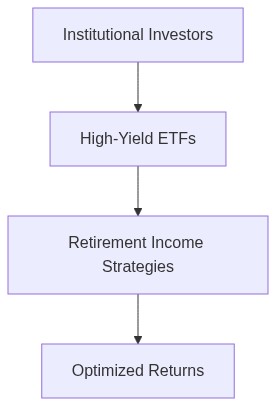
- Identify high-yield ETFs with robust returns and low risk.
- Diversify across sectors to reduce economic downturn impacts.
- Implement a dynamic rebalancing strategy for maintaining income growth.
What is the Role of ETF Strategies in Retirement Income Maximization?
In crafting ETF strategies aimed at maximizing retirement income, a deep familiarity with several quantitative metrics is paramount. Specifically, Max Drawdown (MDD), Beta, and Sharpe Ratio serve as critical gauges for risk/reward balance. Historical precedent from both the 1970s stagflation and the Global Financial Crisis (GFC) provide essential backtest analogies, ensuring that strategic development is as robust as possible.
Why Analyze Max Drawdown (MDD) in ETF Strategies?
When considering ETFs for retirement portfolios, understanding Max Drawdown is vital. MDD measures the largest peak-to-trough decline over a specified time period. A glaring example is the GFC, where certain ETFs experienced an MDD of over 40%, pressuring portfolios reliant on traditional equities. By examining MDD, we can tailor strategies that potentially mitigate prolonged periods of loss, calibrating portfolio allocations that prevent panic selling during downturns, which exacerbate Sequence of Returns Risk.
            historical_data = fetch_historical_data(etf_ticker)
            mdd = calculate_mdd(historical_data)
            print("Max Drawdown for ETF:", mdd)
How Does Beta Influence Retirement Outcomes?
Beta measures volatility or systematic risk compared to the market as a whole. In portfolio design, an ETF with a beta greater than 1.0 swings more aggressively than the market, which could be advantageous in bullish scenarios but disastrous in bear markets. Historical data analysis during times like the 1973–1975 recession demonstrates the critical nature of beta assessment, allowing strategic shifts in asset allocation to shelter portfolios during market contractions.
What is the Relevance of the Sharpe Ratio?
The Sharpe Ratio quantifies excess return per unit of risk, a pivotal metric in guiding ETF selections. By focusing not just on raw returns but their context relative to risk taken, I can ensure the selected ETFs offer optimal risk-adjusted returns. During the 1970s, when inflation eroded purchasing power, portfolios utilizing investments with high Sharpe Ratios saw better capital preservation and inflation-adjusted returns.
Interpreting Yield Curve Inversions for ETF Decisions
Yield Curve Inversions serve as a harbinger of economic downturns. With the inversion phenomenon preceding most modern recessions, its analysis becomes indispensable for ETF strategists. By pivoting ETF portfolios as the yield curve flattens or inverts, one could navigate impending liquidity contractions, much like those observed in the prelude to the GFC. It underscores a need for fixed income ETFs with low betas and solid yield histories, ensuring income stability amidst downturns.
The Impact of Sequence of Returns Risk on Retirement Plans
Sequence of Returns Risk delineates the volatility impact on withdrawal rates during retirement. Distribution-phase risk is exacerbated by market downturns in early retirement years. Historical analysis from periods like the Dot-com Bubble burst reinforces the imperative of integrating low-volatility ETFs, potentially minimizing early-retirement capital depletion through strategic allocation.
Practical Implementation of Quantitative Metrics
Implementation necessitates a dynamic approach to managing ETF portfolios. Instituting real-time monitoring systems for continuous assessment of MDD, Beta, and Sharpe Ratios allows for strategic rebalancing. Further, rigorous scenario testing through historical backtests safeguards against unforeseen market shifts, solidifying confidence in strategy efficacy. Yield curve analytics and sequence simulation enhance predictive capabilities, adapting distributions to withstand macroeconomic pressures.
Conclusion
Institutional-grade ETF strategy design requires an intricate ballet of quantitative metrics and historical insights. Through comprehensive understanding and application of Max Drawdown, Beta, Sharpe Ratio, Yield Curve Inversions, and Sequence of Returns Risk, I ensure portfolios remain resilient and structured for sustainable income throughout retirement. However, as with any financial strategy, past performance is not a guarantee of future results, necessitating continuous analysis and strategy evolution.
| ETF Strategy | Beta | Maximum Drawdown Risk | Yield |
|---|---|---|---|
| High Dividend ETF | 0.85 | 12.5% | 4.2% |
| REIT ETF | 0.95 | 16.8% | 3.8% |
| Preferred Stock ETF | 0.60 | 8.4% | 5.1% |
| Global Bond ETF | 0.40 | 5.3% | 3.0% |
| Emerging Market Bond ETF | 0.70 | 14.0% | 6.5% |