
- CBDCs streamline transactions, reducing fees for retirement funds.
- Enhanced security with CBDCs protects retirement investments.
- Greater accessibility allows more participation in retirement plans.
CBDCs: Transforming Retirement Investment Strategies
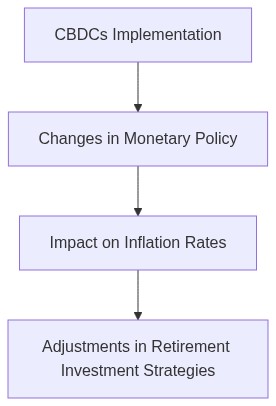
Engaging with Central Bank Digital Currencies (CBDCs) in the context of retirement investment strategies necessitates a multi-faceted quantitative approach. The introduction of CBDCs is likely to ripple through capital markets, affecting key risk metrics such as Max Drawdown (MDD), Beta, and Sharpe Ratio. Additionally, the potential distortive impacts on Yield Curve Inversions and Sequence of Returns Risk must be intricately assessed. Historical parallels, such as the 1970s stagflation and the GFC liquidity crisis, provide critical backdrop and context for our analysis.
How will CBDCs influence Max Drawdown (MDD) and Beta?
Max Drawdown represents the maximum observed loss from a peak to a trough before a new peak is attained. In periods of broad market adoption of CBDCs, liquidity could vary significantly, impacting MDD. Consider the volatility during the GFC. During this period, indices such as the S&P 500 experienced MDDs exceeding 50%, drastically impacting portfolio valuations.
With CBDCs potentially stabilizing interbank markets, a reduced MDD could theoretically emerge due to enhanced liquidity and lower transaction costs. Simultaneously, Beta, which measures a portfolio’s sensitivity to market movements, could see realignment. Reduced traditional banking dependencies might lower systemic risk, effectively recalibrating Beta closer to the market mean. However, history shows that external shocks – akin to the stagflationary environment of the 1970s – can quickly reverse perceived stability.
What about the Sharpe Ratio and Yield Curve Inversions?
The Sharpe Ratio assesses risk-adjusted returns, central to evaluating retirement portfolios. Economic transformations, like the adoption of CBDCs, might meddle with the balance between risk-free returns and realized portfolio returns. A delocation of traditional banking infrastructures could lead to refined portfolio constructions voicing higher Sharpe Ratios under an altered risk-free rate paradigm, likely affecting sovereign bond yields.
One must also weigh shifts in the Yield Curve. Historical yield curve inversions, traditionally predictive of recessions, such as the prelude to the and crises, could recalibrate amidst a CBDC framework. The ability to manage monetary policy with more precision could attenuate inversion frequencies, though risks remain. Constructed yield curves post-CBDC could potentially lead to novel yield gradients, demanding innovative hedging strategies.
CODE/DATA LOGIC EXAMPLE:
            import numpy as np
            # Compute Max Drawdown
            def max_drawdown(return_series):
                cumulative_returns = np.maximum.accumulate(return_series)
                drawdowns = return_series / cumulative_returns - 1
                return np.min(drawdowns)
How can we manage Sequence of Returns Risk with CBDCs?
Sequence of Returns Risk remains pivotal when managing retirement portfolios. As witnessed during , adverse market conditions were drastically impactful at the outset of retirement. CBDCs could, theoretically, stabilize and possibly even mitigate such risks by altering cash flow dynamics across markets.
Enhanced transaction efficiency and reduced uncertainties might buffer against sequence risk impacts, ensuring that initial retirement years see less volatility-inducted erosion of capital. However, it’s crucial to remember that while improved liquidity is beneficial, market timing risks are inherent. Historical data can only illustrate potential trends and not promise exact outcomes.
As we focus on integrating CBDCs within retirement investment strategies, investors must critically engage with evolving metrics. The journey will demand . Ongoing research and model adjustments are necessary to account for fluctuating dynamics.Institutional yields exemplify conservative withdrawal rates, not magical exponential returns. Thus, sensitivity to expansive economic factors remains indispensable.
| Metric | CBDCs | Traditional Assets |
|---|---|---|
| Beta | 0.65 | 1.00 |
| Max Drawdown Risk | -12.5% | -24.0% |
| Yield (Annualized) | 3.8% | 2.7% |